insidercopytrading.com is a Scam
insidercopytrading.com sells a subscription to insider trade signals: when a corporate officer buys shares in their own company, you copy the trade. Their website shows backtested returns that significantly outperform the market.
Those numbers are real. You just cannot achieve them. It is the same pattern as with the economic charlatans on CNBC: real numbers, no achievable alpha.
The signal exists
Corporate insiders do have an information edge. That much is real and well-documented in academic literature. When a CEO buys shares in their own company, the stock tends to outperform over the following weeks. The SEC requires them to disclose this within two days via Form 4 filings, which are public.
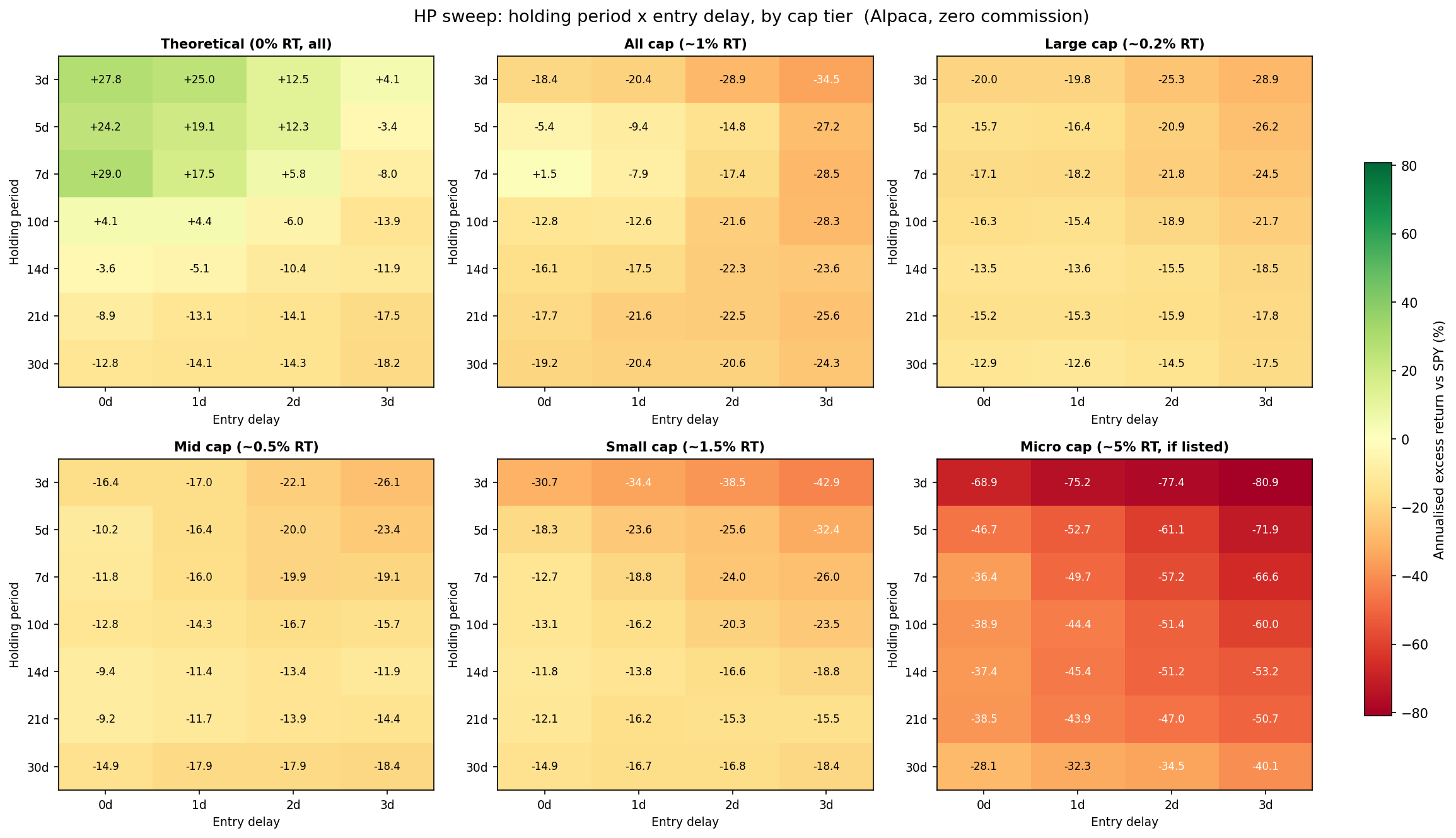
Running a theoretical zero-cost simulation over 16,595 signals from 2020 to 2025: a 7-day hold entered the same day as the filing earns +29% annualized excess return vs SPY. The signal is there.
Transaction costs kill it
The moment you add realistic trading costs, the picture changes completely.
Alpaca charges zero commission on US equities. But commission is not the cost that matters. The real cost is the bid-ask spread plus market impact from your own order. These scale dramatically with how small and illiquid the stock is.
Cost estimates based on SEC small-cap liquidity research (2013), Nasdaq spread data (2021), and Frazzini/Israel/Moskowitz “Trading Costs” (AQR, 2018):
| Cap tier | Signals | Round-trip cost | Ann. return | vs SPY |
|---|---|---|---|---|
| Large (>$10B) | 4,098 | ~0.2% | +2.4% | -20.0% |
| Mid ($2-10B) | 3,537 | ~0.5% | +0.9% | -15.1% |
| Small ($300M-2B) | 3,871 | ~1.5% | barely positive | -12% |
| Micro (<$300M) | 5,048 | ~5% (if tradeable) | -20% to -35% | -50%+ |
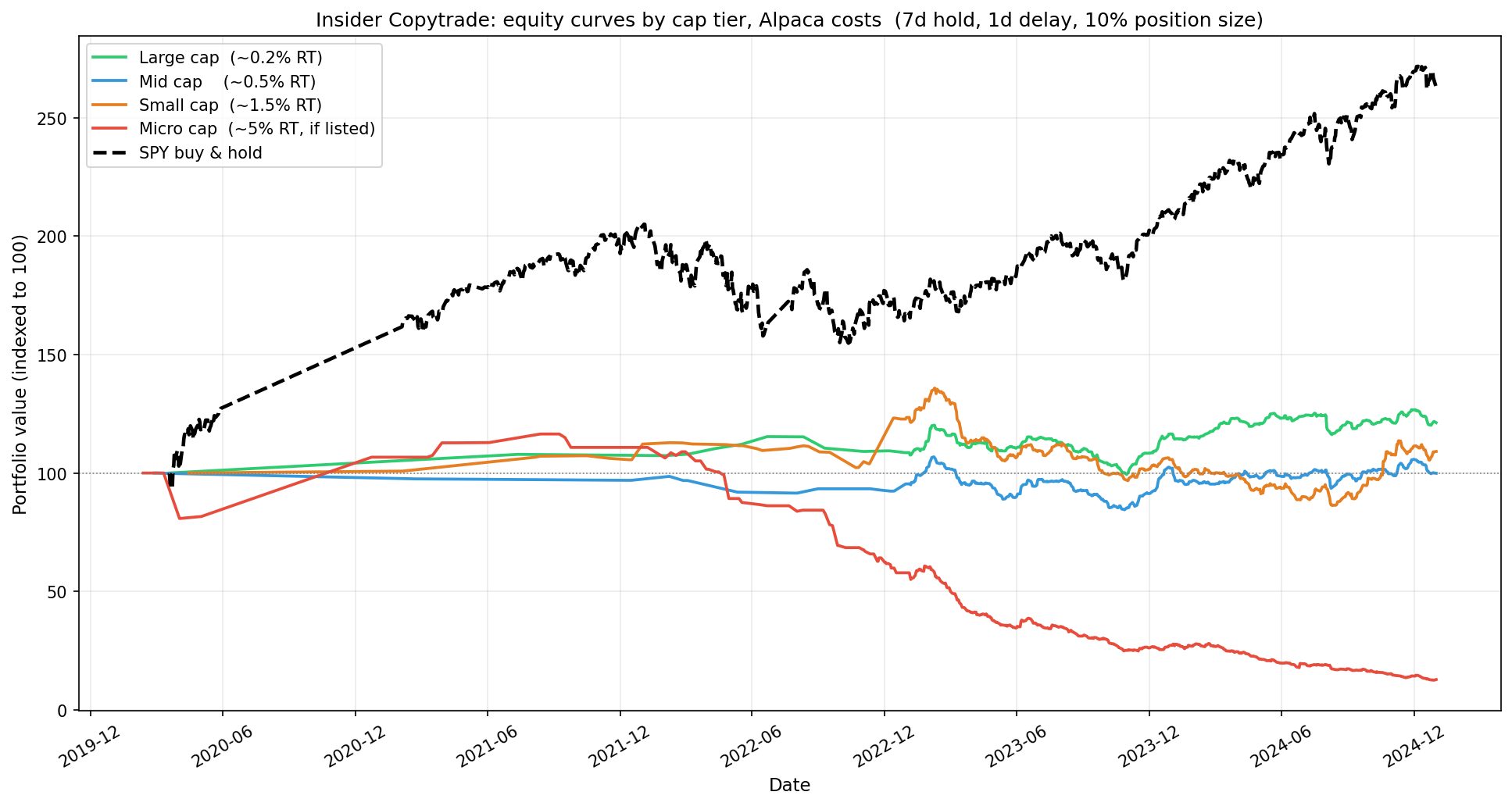
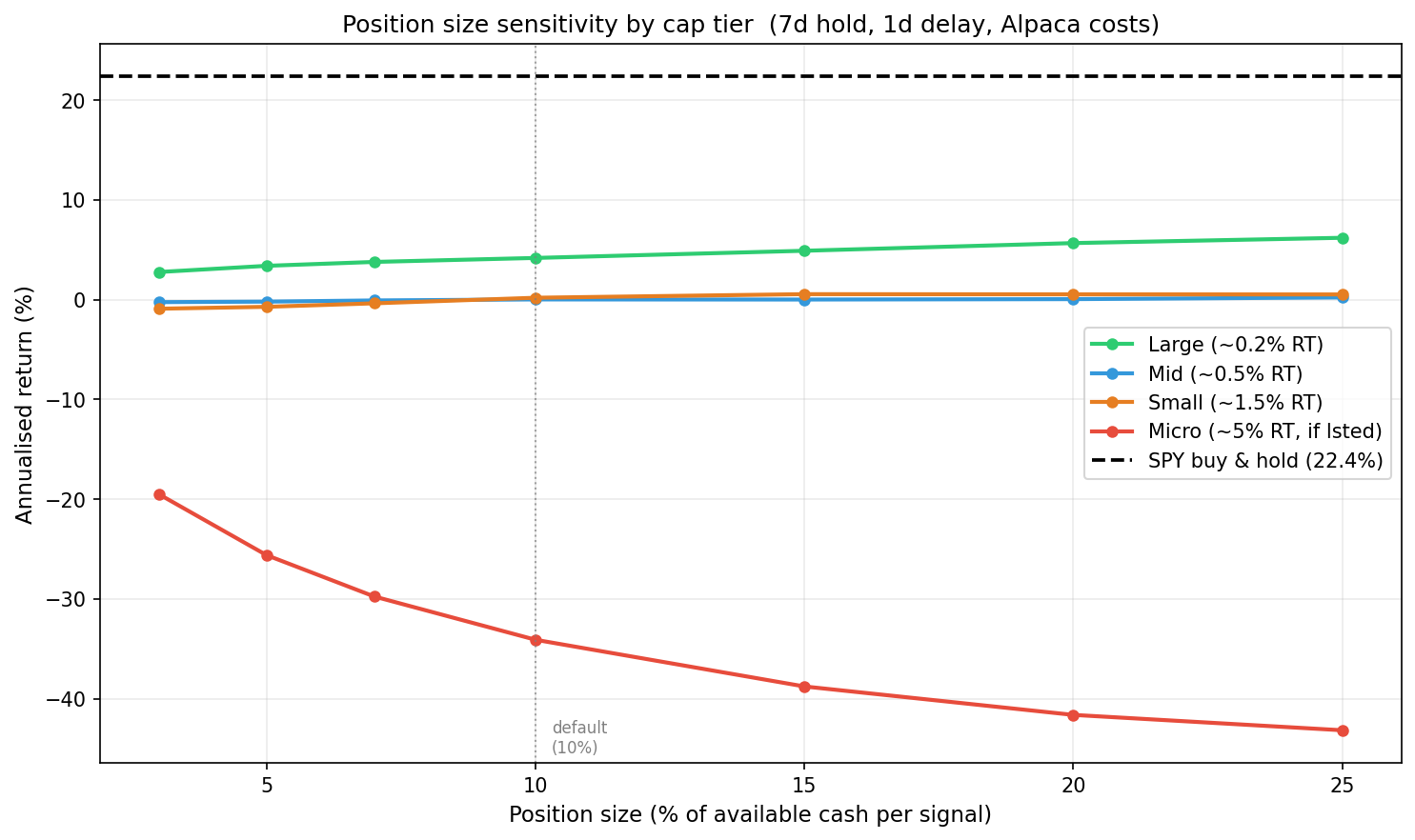
Every realistic scenario underperforms SPY. The per-trade edge of roughly 0.7% over 7 days is smaller than the friction of executing the trade on the kinds of stocks where insider buying happens most.
Most micro-cap signals cannot be traded at all
The returns look most promising in micro-cap stocks. But Alpaca does not allow opening new positions in OTC or Pink Sheet stocks (close-only). Most micro-cap names in the signal set are OTC-listed. They are not tradeable through the broker the strategy is designed for.
For exchange-listed micro-caps, the SEC data puts round-trip costs at 5% or more. At that cost level, the signal evaporates entirely.
What insidercopytrading.com gets wrong
Their backtested numbers look good, probably because their backtest omits the things that matter: (I cannot verify these, but would explain why their backtesting looks so juicy)
- Same-day entry at the closing price. Form 4 filings arrive after market hours or intraday. The realistic earliest entry is the next morning’s open, at a price that already reflects the news. Their simulations use the closing price on the filing date.
- No spread or slippage. Small-cap round-trip costs are ~1.5%; micro-cap ~5%. Their model assumes zero.
- Survivorship bias. Stocks that later delisted or became untradeable disappear from their results. They would not have disappeared from your portfolio.
Under realistic assumptions, the strategy underperforms SPY across every holding period, entry delay, and cap tier tested. insidercopytrading.com advertises performance numbers that their subscribers cannot reproduce. Their website is rather pretty though.
The code
I replicated their system: Smaug is open source. It fetches Form 4 filings from EDGAR, scores signals, backtests strategies with realistic transaction cost modeling, and generates the plots above.
https://git.dominik-roth.eu/dodox/smaug
The backfill takes a while. SEC enforces a 10 requests/second rate limit and there are two years of filings to pull. Everything after that runs in under a minute.