On the Chinese Economy
The Soviet Union led the space race on almost every metric: first satellite, first human in orbit, more powerful engines. They still lost. Not because the technology was bad, but because they optimized for impressive rather than sufficient.
China’s Structural Problem
China’s economy has two features that compound each other.
First, it is less market-driven than its competitors. The government sets industrial direction and provides access to below-market credit. When a strategic sector is chosen, capital flows into it regardless of return on investment, and when loans fail, the political calculus (not the financial one) determines who gets rescued.
Second, domestic consumption is structurally low. Chinese households consume around 40% of GDP versus a global average above 60%. The gap was historically filled by investment and exports. When the property market, the primary household savings vehicle, stopped appreciating, that gap had nowhere to go. The bubble isn’t growing, but the wealth destruction from its deflation has already happened, sitting on household balance sheets as reduced spending power.
The result: a machine that produces enormous output with no sufficient domestic market to absorb it.
Electric Vehicles: The First Test Case
China built out EV manufacturing capacity well beyond what its domestic market or export markets can absorb. The domestic addressable market is smaller than it looks; a large fraction of the population simply cannot afford a new car at any price. The obvious export destinations are closing: the EU imposed steep tariffs, the US market is essentially shut, Russia is too cold and too oil-rich, India has its own preference for cheaper CNG vehicles, and Africa is not yet wealthy enough to be a real market.
The consequence is a price war that is good for global consumers and destructive for Chinese producers. Most Chinese EV makers are unprofitable. The loans funding the factories still need to be paid back.
Humanoid Robots: Running It Again
The same logic is now being applied to humanoid robots. China has over 150 humanoid robot companies, billions in local-government funding committed, and factories being built for units that don’t have confirmed buyers.
The underlying problem is that the AI required for useful general-purpose humanoids doesn’t exist yet. Current robots can perform choreographed dances and execute narrowly defined repetitive tasks in controlled environments. The path to a robot that works in unstructured real-world settings requires either a breakthrough in vision-language-action models (uncertain), a long grind through reinforcement learning (slow, possibly decades), or something we don’t know yet. Building factory capacity ahead of that breakthrough is speculative at best.
What China Gets Right
Not everything follows this pattern. Solar is the clearest counterexample: global demand was real and large, and costs dropped fast enough that Chinese producers achieved genuine price advantages rather than just subsidized market share.
China’s work on Open-source LLMs is also clever. Developing frontier models is expensive; replicating them (esp. when training off of frontier model outputs) is cheap. By commoditizing the weights, Chinese labs make it structurally difficult for Western companies to recoup the original R&D investment, they can’t price above cost-to-serve.
Conclusion
This post isn’t a verdict. The structural problems are real, the credit-driven overcapacity pattern, the weak domestic consumption base, the property wealth destruction. But China has also demonstrated it can execute at scale when the underlying demand exists. The question is whether EVs and humanoid robots are more like solar (real demand, timing worked out) or more like Soviet rocketry (impressive, optimized for the wrong thing). I do not know.
Somewhat related. Recently saw this tweet:
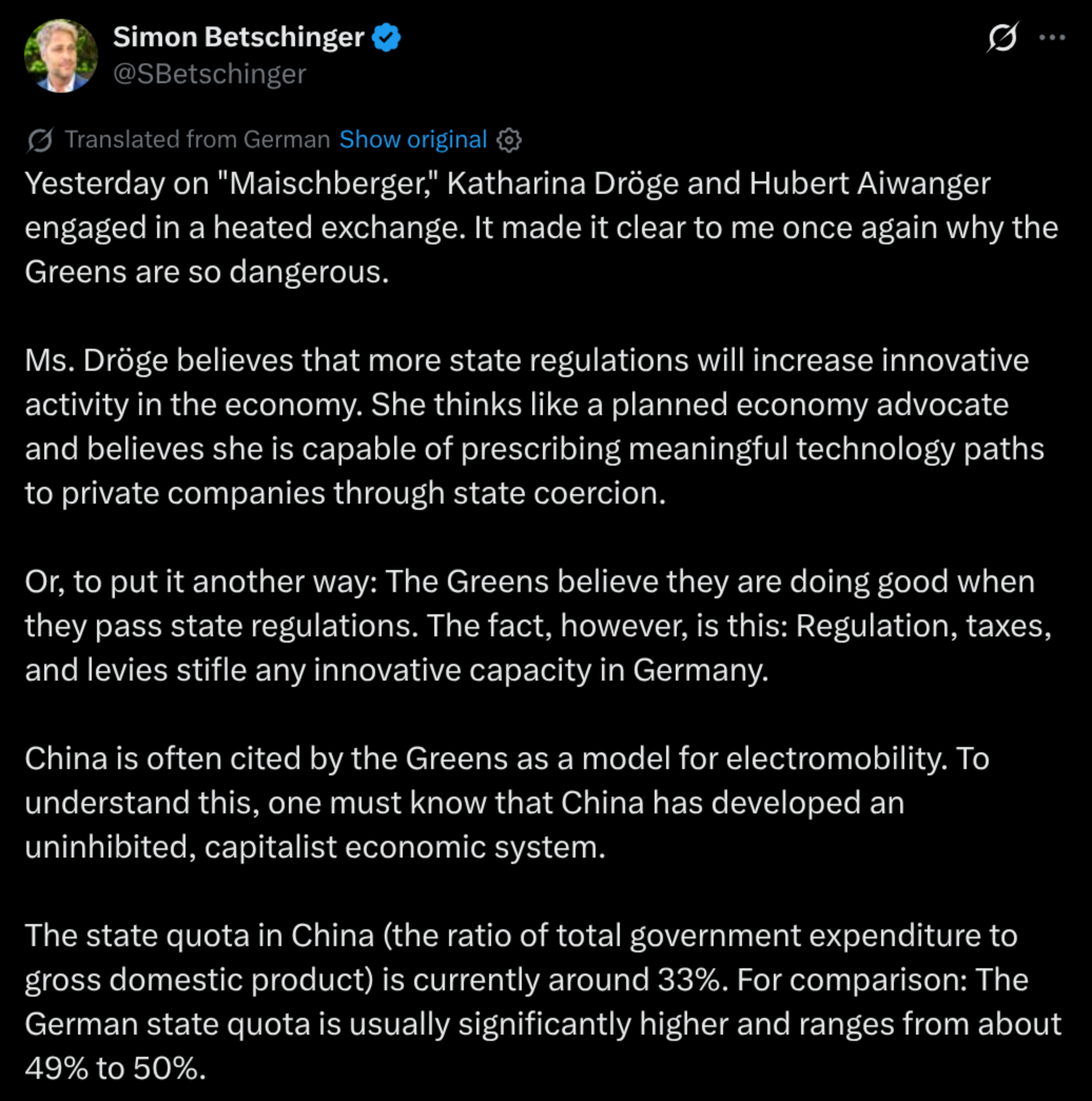
Ignoring the critique of state intervention, just looking at the provided numbers: Germany’s 49% includes ~31% social transfers; China’s 33% excludes the off-budget machinery that actually steers production. SOE assets at 194% of GDP, LGFVs at ~47-50% of GDP, policy banks, and directed lending never appear in the Staatsquote. The EV “capitalist success” was built on $230.9bn in state support (CSIS, 2009-2023). That off-budget machinery is precisely what makes the overcapacity dynamic described above possible.
Key Numbers
| Metric | China | Germany |
|---|---|---|
| General govt expenditure / GDP | ~32.9% (2025, IMF) | ~49.5% (2024, Eurostat) |
| Of which: social transfers / GDP | ~5-6% (no welfare state) | ~31.2% |
| Net public investment / GDP | high, but ~entirely off-budget | ~0% net (gross ~2.3%) |
| SOE assets / GDP | ~194% (2018, IMF Fiscal Monitor) | ~12.6% (KfW only) |
| Off-budget local debt (LGFV) / GDP | ~47-50% (IMF, end-2024) | n/a |
| Augmented fiscal deficit / GDP | ~14.3% (2025, IMF) | ~2.8% (2024) |
| Heritage Economic Freedom 2026 | 48.3: “repressed” | 71.7: “mostly free” |
| Fraser Economic Freedom of the World 2025 | 108th / 165 | 15th / 165 |
Sources
- IMF World Economic Outlook (2025); IMF People’s Republic of China: Selected Issues (2021)
- Eurostat / Destatis
- IMF Fiscal Monitor — augmented debt / LGFV estimates
- CSIS / CNBC (June 2024) — $230.9bn China EV subsidies
- Heritage Foundation Index of Economic Freedom (2026)
- Fraser Institute Economic Freedom of the World (2025)
- Sheng & Zhao, The China Quarterly (2023) — guidance funds
- Nicholas Lardy, The State Strikes Back (PIIE, 2019)